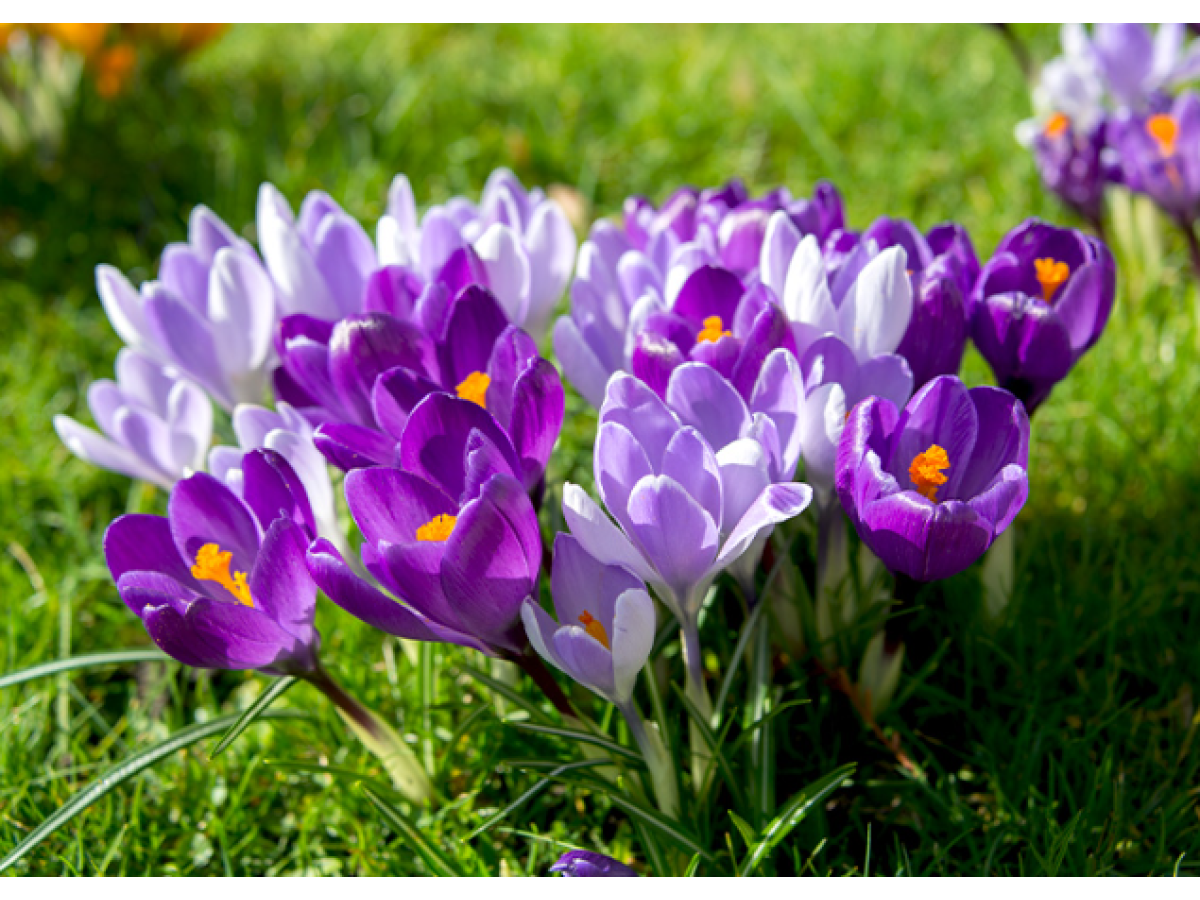
A neighbor at the dacha complains every year about the same thing: in the first year, crocuses explode with color as early as February, but by the next spring, there are rare single flowers on the flowerbed or even an empty space. The blame usually falls on the weather or "bad soil," although in reality the reason is that
crocus bulbs require special care after flowering, which few people think about — all the focus is on the planting moment, not on what happens to the plant after the petals have fallen off.
What happens underground after flowering
While the flower pleases the eye, the bulb goes through its most important stage — accumulating nutrients for the next season. The leaves, which many cut off immediately after the flower wilts for the sake of a neat flowerbed, actually work like a solar battery: it is through them that the bulb recharges. If the leaves are removed prematurely, the bulb goes into winter exhausted and in spring will either not sprout or produce a weak flower.
In practice, it looks like this: gardeners who grow crocuses for sale in the Netherlands leave the leaves to dry naturally for at least 6 weeks after flowering ends — according to the Dutch association of bulb producers (KAVB), this period is sufficient for the bulb to fully restore its energy reserve.
Signs of a quality bulb — a short checklist before planting
Not every bulb that looks intact is capable of producing a full flower. Before planting, it is worth checking a few things:
- Density to the touch — the bulb should not spring or bend; softness means the beginning of rot.
- No mold near the bottom — a grayish coating at the bottom indicates fungal damage that spreads to neighboring bulbs in the soil.
- Size according to the variety — for large-flowered species, a small bulb (less than 7 cm in circumference) most often produces only leaves without a bud in the first year.
- Intact scaly covering — even small cracks open the way for moisture and rodent larvae inside.
Those who focus specifically on large-flowered varieties usually pay attention to
buy large-flowered crocuses with clear bulb size marking — this is one of the few parameters that actually predicts the size of the future flower, unlike the packaging color or the photo on the label.
Common mistake with autumn watering
Many confuse caring for crocuses with caring for tulips or hyacinths, although their regimes are different. Crocuses cannot tolerate stagnant moisture in the soil in autumn — it is overwatering, not frost, that most often kills the bulbs before spring. Drainage during autumn planting is more important than depth or fertilizer.
| Mistake |
Consequence |
What to do instead |
| Early cutting of leaves after flowering |
Bulb exhaustion, weak flowering the next year |
Wait for complete yellowing of leaves |
| Planting in heavy clay soil without drainage |
Bottom rot in autumn |
Add sand or fine gravel to the hole |
| Storing bulbs in a plastic bag |
Condensation buildup, mold |
Paper bags or mesh bags |
| Too dense planting |
Competition for nutrients, smaller flowers the next season |
Distance of 5–8 cm between bulbs |
The difference between a flowerbed that blooms for years in a row and one that fades already in the second spring is most often hidden precisely in these details, and not in the quality of the planting material itself.
Questions that most often arise after planting
Do I need to dig up crocus bulbs for the summer, like tulips? No, for most garden varieties this is unnecessary. Crocuses overwinter in the soil for several years in a row, and digging them up does more harm than good if the area is not waterlogged and does not require replanting.
After how many years should the bulbs be replanted? The guideline is 3–4 years. During this time, the mother bulb forms several small offsets around itself, the flowerbed becomes denser, and the flowers become crowded — flowering becomes smaller even with ideal care.
Can crocuses be planted next to tulips and daffodils in the same hole? Technically yes, but not advisable — crocuses have a different moisture regime and planting depth (5–7 cm vs. 10–15 cm for tulips), so shared watering will be excessive for some and insufficient for others.
What to do if the bulb produced only leaves without a flower in spring? This is almost always a sign of exhaustion — either from last year's early cutting of leaves or from tight planting. The simplest solution is to let the plant finish leafing out this season and replant in autumn, without waiting for another weak cycle.